Fixing My Hip and Pelvic Alignment Helped Strengthen my core
If you’re experiencing hip pain, pelvic floor dysfunction, or lower back discomfort, your deep core and pelvic floor muscles could be the missing link. The way your hips rotate, your hip and pelvic alignment, and how your muscles activate all play a key role in determining your overall core stability, mobility, and even posture.
In this blog, we’ll break down why pelvic alignment and hip rotation matter, how they connect to pelvic floor function, and simple exercises to build stability and strength in these key areas.
The Connection Between Your Hips, Pelvis & Core
Your pelvis is the foundation of your core. When properly aligned and supported by strong glutes, deep core and pelvic floor muscles, and hip rotators, your body moves efficiently. However, when misaligned, it can lead to pain, weakness, and instability.
Key Functions of the Pelvis & Hips:
- Pelvic alignment affects core activation – Anterior or posterior pelvic tilt can limit deep core engagement.
- Hip rotation affects pelvic floor function – Poor hip rotation can lead to tight or weak pelvic floor muscles.
- Glute strength stabilizes the pelvis – Weak glutes contribute to lower back pain and improper movement mechanics.
Internal vs. External Hip Rotation & Why It Matters
Your hips must rotate properly to allow smooth movement, pelvic floor function, and deep core and pelvic floor muscles stability. Many people either lack hip rotation or overcompensate, leading to muscle imbalances and pain.
Two Types of Hip Rotation:
1. Internal Rotation:
- Essential for deep core engagement and pelvic floor activation.
- Helps with stability in walking, running, and lifting.
- Commonly limited in people with tight glutes and hip flexors.
Try This Internal Rotation Check:
- Sit with legs straight.
- Rotate one leg inward, keeping the knee straight.
- If movement is limited, you may have restricted internal rotation.
2. External Rotation:
- Helps with balance, glute activation, and overall hip stability.
- Allows for proper squat depth and lower back support.
Try This External Rotation Check:
- Sit with legs bent, feet together.
- Let your knees fall outward.
- If there’s discomfort or restriction, you may have tight adductors or weak glutes.
How Hip & Pelvic Position Affects the Pelvic Floor
Your pelvic floor muscles rely on proper hip and pelvic mechanics to function effectively. If your hips are too tight or weak, your pelvic floor may either be overactive (tight and unable to relax) or weak (lacking control and strength).
Signs of Pelvic Floor Dysfunction from Hip Imbalances:
- Leaking urine with jumping, coughing, or sneezing.
- Lower belly pooch that won’t go away.
- Hip or lower back pain that worsens with exercise.
Key Exercises to Improve Hip & Pelvic Floor Function
1. Seated Hip Internal Rotations
- Sit on the floor, legs bent at 90 degrees.
- Slowly rotate one knee inward while keeping the foot planted.
- Repeat 10 times per side to improve internal rotation.
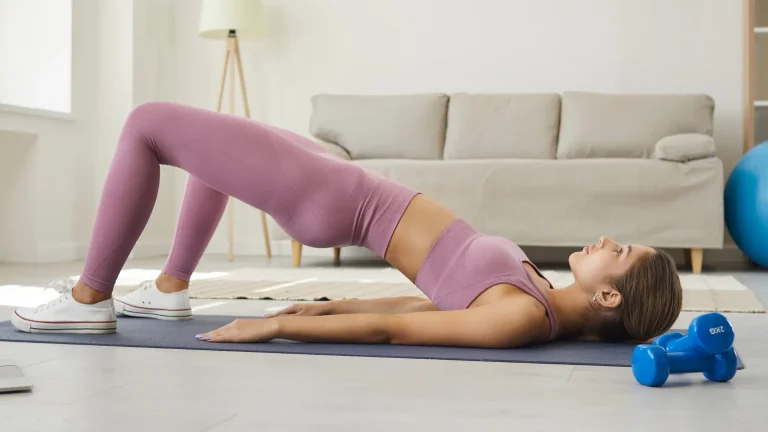
2. Glute Bridge with Hip Rotation
- Lie on your back, knees bent, feet flat.
- Lift hips while keeping core engaged.
- At the top, gently rotate knees outward, then back to neutral.
- Repeat 12-15 times for better glute and pelvic floor activation.
3. Bird Dog for Core & Pelvic Stability
- Start in a quadruped (hands and knees) position.
- Extend opposite arm and leg while keeping your core engaged.
- Hold for 3 seconds, return to start.
- Repeat 8-12 reps per side to build core, hip, and pelvic stability.
Stop Clenching: Why Relaxing the Hips & Pelvic Floor Matters
Many women unknowingly clench their pelvic floor and hip muscles, causing tightness, poor blood flow, and pain. Instead of gripping, focus on controlled strength and relaxation.
Try This Clenching Awareness Test:
- Stand and notice if you’re squeezing your glutes or gripping your inner thighs.
- Try relaxing the muscles and taking slow, deep breaths into your belly.
- If relaxing feels difficult, you may have chronic tension in your hips or pelvic floor.
Final Thoughts: Strengthen Your Core from the Hips Up
Your hips and pelvis play a major role in core strength and pelvic floor function. By improving hip rotation, glute activation, and deep core and pelvic floor muscles control, you can move with more stability, reduce pain, and enhance your workouts.