8 Foam Roller Exercises to Improve Posture & Strengthen Your Core
Do you still feel like your core is weak, even months (or years) after having kids? You’re not alone. Many women unknowingly rely on their lower back and hips instead of properly engaging their deep core muscles—leading to back pain, a lingering ‘mom pooch,’ and even leakage during workouts.
The good news? With the right foam roller exercises, you can rebuild core strength from the inside out. Keep reading for a simple yet powerful 15-minute Pilates inspired routine to activate and strengthen your deep core and pelvic floor muscles.
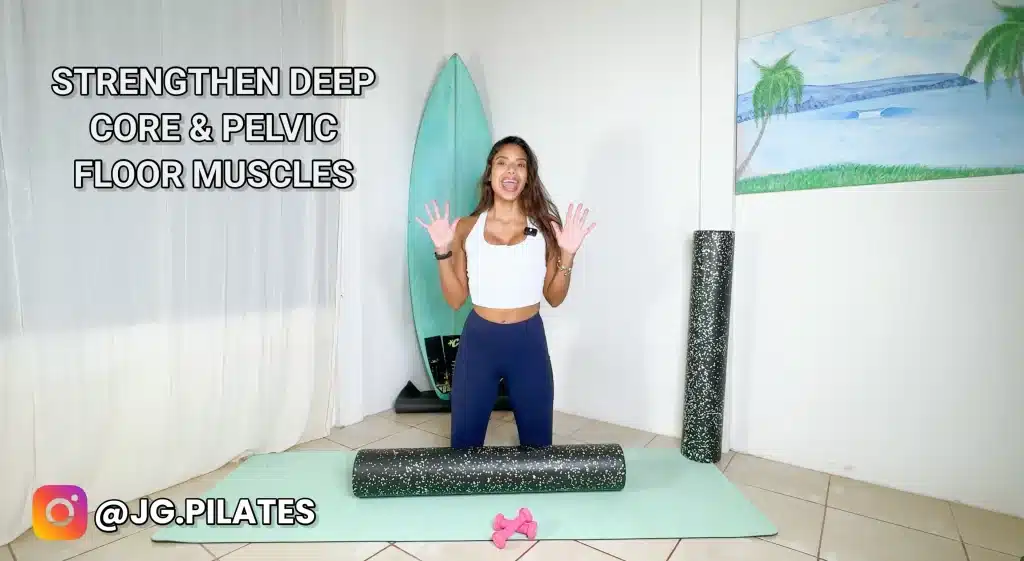
Pilates Foam Roller Workout Plan
| # | Time Stamp | Exercise | Reps |
|---|---|---|---|
| 1 | 1:30 | Deep Core Activation | 8-12 |
| 2 | 2:11 | Chest Opener | 8-12 |
| 3 | 3:42 | Arm Swivels | 8-12 |
| 4 | 5:08 | Single Leg Toe Taps | 8-12 |
| 5 | 7:27 | Single Leg Stretch | 8-12 |
| 6 | 9:24 | Double Leg Stretch | 8-12 |
| 7 | 10:42 | Dead Bug | 8-12 |
| 8 | 14:07 | Cat Cow | 8-12 |
Foam Roller Exercise Benefits
| # | Foam Roller Exercise | Foam Roller Exercise Benefits |
|---|---|---|
| 1 | Deep Core Activation | Engages the transverse abdominis and pelvic floor, helping with postpartum recovery and core stability. |
| 2 | Chest Opener | Improves posture by opening up the chest and counteracting hunching from pregnancy, breastfeeding, and daily activities. |
| 3 | Arm Swivels | Activates the shoulders and thoracic spine, improving upper body mobility and reducing tension. |
| 4 | Single Leg Toe Taps | Strengthens the deep core and pelvic floor while improving coordination and balance. |
| 5 | Single Leg Stretch | Enhances core endurance and hip mobility, promoting better spinal alignment. |
| 6 | Double Leg Stretch | Challenges core stability and control, improving overall abdominal strength. |
| 7 | Dead Bug | Builds core and lumbar stability, preventing lower back pain and improving functional strength. |
| 8 | Cat Cow | Cat-Cow with a foam roller enhances spinal mobility, relieves tension in the back, and deepens core activation for better posture and flexibility |
Foam Roller Exercises Pilates FAQs
1. Are foam roller exercises effective?
Yes, foam roller Pilates is highly effective for improving core stability, balance, and muscle activation. The unstable surface challenges your deep core muscles and enhances postural alignment, flexibility, and overall strength. It also helps release muscle tension and improve mobility, making it an excellent tool for both strength and recovery.
2. What size foam roller is best for Pilates?
The best size foam roller for Pilates is a 36-inch (90 cm) long roller with a diameter of 6 inches (15 cm). This length provides full support for the spine, shoulders, and pelvis, making it ideal for core exercises, spinal alignment, and balance work. A soft-density roller is also recommended for beginners or those with sensitive muscles.
3. How to use a foam roller for Pilates?
A foam roller can be used in Pilates for core strengthening, balance training, and muscle release. Here are some common ways to use it:
- Core Activation: Lie on the roller lengthwise and perform single-leg toe taps, marches, and roll-ups.
- Spinal Mobility: Use it for chest openers, cat-cow variations, and thoracic extensions.
- Balance Work: Challenge stability with dead bugs, leg lifts, and arm circles.
- Self-Massage: Roll over tight areas like the upper back, quads, and hamstrings to relieve tension.
4. Is 20 minutes of Pilates a day enough?
Yes, 20 minutes of Pilates per day can be highly effective, especially if you’re consistent. Short daily sessions can help build core strength, improve posture, enhance flexibility, and reduce pain. For best results, focus on quality over quantity, ensuring you engage the deep core and move with control. If you’re aiming for weight loss or muscle toning, combining Pilates with cardio or strength training can be even more beneficial.